Critical scholars of the NT hold that we do not know who really wrote the gospels. While modern Bibles attribute the four gospels to Matthew, Mark, Luke, and John, according to their view, these names were added later.

Indeed, NT critic Bart Ehrman contends that the gospels originally did not contain authorship titles, and in fact, these titles didn’t arrive until a century after they were written.[1] In his view, later Christians added the superscriptions containing authorship to give the four gospels their “much needed authority.”[2]

Does the evidence support the authorship of Matthew, Mark, Luke, and John? Yes. Indeed, several independent lines of evidence support the standard, historically accepted authorship of the four gospels, while the “anonymous theory” of gospel authorship fails to adequately explain the data.

The anonymous theory doesn’t adequately explain the MANUSCRIPT EVIDENCE

We do not possess the original documents written by the authors of the gospels. But, to be fair, we do not currently possess any original manuscripts from antiquity. With the gospels, however, several thousand copies have come down to us from history—far more than any other ancient document (see “The Bibliographical Test”).

And all of these manuscripts (without exception!) contain superscriptions at the beginning with the traditional authors’ names (e.g. KATA MATTHAION, KATA MARKON, etc.). This is true regardless of the language or the age of the manuscript. While we might speculate whether or not the original documents contained a title, all ancient manuscripts do indeed have this title. Martin Hengel writes,

Let those who deny the great age and therefore the basic originality of the Gospel superscriptions in order to preserve their ‘good’ critical conscience give a better explanation of the completely unanimous and relatively early attestation of these titles, their origin and the names of the authors associated with them. Such an explanation has yet to be given, and it never will be.[3]

We don’t know if these manuscripts originally had titles. However, in the first century AD, “Most authors gave their books titles, but the practice was not universal.”[4]

The anonymous theory doesn’t explain the authorship of MARK and LUKE

The later Gnostic gospels ascribe “heavy hitters” as the authors of their gospels. These are titled, “The gospel according to Peter” or “The gospel according to Thomas.” Of course, these documents date to the late second century or later, and they couldn’t have been written by the first century people (see “The New Testament Canon”). But the choice of authorship shows us something very important: Counterfeit authors picked names that seemed authoritative and authentic, placing popular NT figures as the authors of their books.

With this in mind, consider the gospel according to Mark and the gospel according to Luke: Why would the early Christians invent these names? If these gospels really demanded a “much needed authority,”[5] why did the scribes pick authors who were not eyewitnesses and also such obscure NT figures?

The anonymous theory is IMPLAUSIBLE

Under the critical view, the original manuscripts were anonymous, and these spread across the Roman Empire for a full century. These copies spread from Jerusalem to Rome to Africa, as scribes copied and recopied the four gospels. Then, after reaching the four corners of the empire, all of these separate scribes just so happened to assign the exact same names to these manuscripts.

And remember, this was all before cell phones and email!

It would be a remarkable feat for so many scribes from such remote locations to all coincide in such a seamless way. Indeed, this would be simply astonishing for just one gospel—but four? Such a theory is implausible for thinking people.

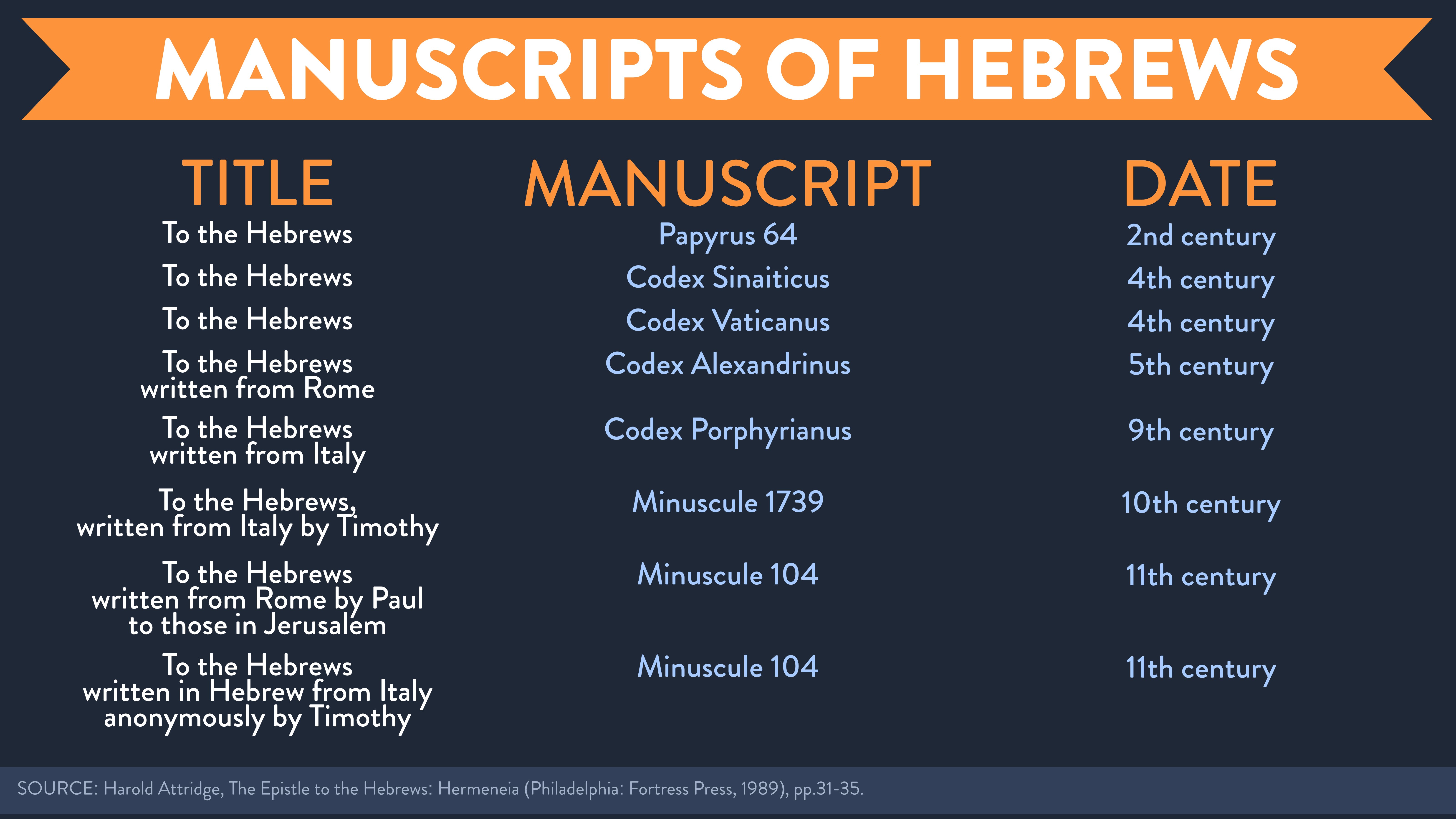
How could these scribes all synchronize such a massive conspiracy, and why can’t we find a single anonymous or pseudonymous copy of a gospel? A good comparison to this phenomenon is the letter to the Hebrews which is truly anonymous. And yet, our manuscript evidence demonstrates various titles throughout time—far different from the constancy and consistency of the four gospels.


How different this is from the four gospels! The gospels have far more manuscripts, but literally no variation in their superscriptions. Meanwhile, the letter to the Hebrews has far fewer manuscripts with far more variation in the superscription.

The anonymous theory is IMPRACTICAL

Justin Martyr (AD 150, Palestine) stated that the early Christians would read from “the memoirs of the apostles” (First Apology 67), which, to be clear, he also called “gospels” (66). But think about this: When these churches read from these multiple gospels, it would have become practically necessary to have names for each in order to distinguish one from another.[7] Are we honestly to believe that Christian communities read from various gospels for a full century without assigning them titles? The titles presuppose that other Gospels existed; otherwise, they wouldn’t have the title “according to _________.”[8]

The anonymous theory is UNHISTORICAL

The early church valued both the authorship and apostolicity of the gospels. That is, it mattered to the early Christians who wrote a gospel and what their authority was. Tertullian (AD 210, Carthage) states, “A work ought not to be recognized, which holds not its head erect… which gives no promise of credibility from the fullness of its title and the just profession of its author” (Against Marcion, 4.2). Likewise, Irenaeus (AD 180) held that those who denied Matthew, Mark, Luke, and John were denying “the companions of the Lord” (Against Heresies, 3.1.2). Indeed, one way we know that the early Christians valued the writings of apostles so much is to look at the titles of Gnostic gospels, which are largely apostolic figures (e.g. Peter, Thomas, Bartholomew, Judas, Philip, etc.).

The anonymous theory doesn’t explain the EXTERNAL and INTERNAL evidence

What is external evidence? This type of evidence comes from outside a historical manuscript. For instance, a text of history can be supported by independent documents, archaeological discoveries, or any other evidence. In the case of the authorship of the gospels, we will look at the view of the early Christian leaders, thinkers, and writers—whom historians refer to as the Church Fathers.

What is internal evidence? This type of evidence comes from inside the historical manuscript itself. For instance, we would check to see if statements in the document supported the author or counted against him. To give an example, some claim that Paul was the author of the letter to the Hebrews, because the author is close to Timothy—a close friend of Paul (Heb. 13:23). This is good internal evidence in favor of Paul. However, others note that the author states how Jesus’ salvation was “confirmed to us by those who heard” (Heb. 2:3). It is argued that this is good internal evidence against Paul as the author.

With this in mind, let’s consider both the external and internal evidence for each gospel, starting with Matthew.

Matthew

Internal evidence for Matthew’s authorship. There are many signs within the gospel that this biography was written by a tax collector:

First, the gospel names Matthew as a tax collector (Mt. 9:9; 10:3), and “Matthew’s Gospel shows the greatest level of financial interest, including numerous references to money and treasure that Matthew alone records.”[9] He mentions the expensive gifts of the magi (Mt. 2:11), various parables about money (Mt. 13:44-46, 52; 18:23-35; 20:1-16; 25:14-30), various tax collectors (Mt. 5:46; 9:10-11; 11:19; 17:24-27; 18:17; 21:31-32; 22:17-19), money paid to Judas (Mt. 27:3), and the money bribed to the guards at Jesus’ tomb (Mt. 28:12). By contrast, John doesn’t mention tax collectors at all.

Second, as a tax collector, it’s reasonable that Matthew would’ve been literate, so he could write a gospel.

Third, the title (“The gospel according to Matthew”) fits the name in the gospel, rather than the name “Levi” used by Mark (2:14) and Luke (5:27-29).[10]

Finally, this passes the criterion of embarrassment. That is, it’s odd that the author or the early church would claim that a “tax collector” (Mt. 10:3) wrote a gospel. Why wouldn’t they pick a more famous apostle? Blomberg writes, “Matthew, of course, was an apostle but, next only to Judas who betrayed Jesus, probably the least respected figure of the Twelve in Jewish circles because he had worked for the occupying enemy forces by collecting customs tolls for Rome.”[11]

External evidence for Matthew’s authorship. Various church fathers affirmed Matthew’s authorship, and these witnesses reach all the way from Turkey to Palestine—from France to Africa.

Papias (AD 130, Hierapolis—modern day Turkey): “Matthew composed the sayings in the Hebrew dialect and each person interpreted them as best he could” (Church History 3.39.16).[12]

Justin Martyr (AD 150, Israel) doesn’t refer to Matthew by name, but he attributes Matthew 16:17 as “recorded in the memoirs of His apostles” (Dialogue with Trypho 103.8).

Irenaeus (AD 180, Lyons, France): “Matthew also issued a written Gospel among the Hebrew in their own dialect, while Peter and Paul were preaching at Rome” (Against Heresies 3.1.1; cf. Church History 5.8.2).[13]

Clement of Alexandria (AD 215, Egypt): “Of all those who had been with the Lord only Matthew and John left us their recollections, and tradition says they took to writing perforce. Matthew had first preached to the Hebrews, and when he was on the point of going to others he transmitted in writing in his native language the Gospel according to himself, and thus supplied by writing the lack of his own presence to those from whom he was sent” (Church History 3.24.5-6).

Matthew was the most quoted gospel during the first 300 years of the church,[14] and “the universal testimony[15] of the early church is that the apostle Matthew wrote it, and our earliest textual witnesses attribute it to him (KATA MATTHAION).”[16]

Mark

Internal evidence for Mark’s authorship. Within the book itself, we discover several clues that point toward Peter supervising Mark as the author. To be clear, this evidence isn’t conclusive, but it does support a cumulative case:

First, by percentage, Mark refers to Peter more than any other gospel author (26x versus Matthew’s 29x). This could show that Peter’s point of view is more represented, because he oversaw the authorship of the book.

Second, the author never refers to Peter as “Simon Peter.” This is quite odd because the name Peter was a very common name in Israel at this time. And yet, the author never feels the need to identify Peter as Simon Peter—only as “Simon” or as “Peter.” This implies a familiarity with Peter.

Third, the author mentions Peter as the first disciple (Mk. 1:16) and the last (Mk. 16:7). This forms an inclusio (i.e. “bookends” for the work) that demonstrates the author’s focus on Peter.[17]

Fourth, the author refers to Capernaum as “home” (Mk. 2:1). Of course, Jesus didn’t grow up in Capernaum, so why call it home? Whose home? The text tells us that Capernaum was Peter’s home (Mk. 1:21, 29-31), which again betrays that the author wrote from Peter’s perspective.

Fifth, Mark was with Peter and Paul in Rome, according to the NT. Paul was with Mark in Rome (Col. 4:10; Philem. 24; 2 Tim. 4:11), as was Peter (1 Pet. 5:13). Peter also refers to Mark as “his son” (1 Pet. 5:13), which implies a close relationship.

Sixth, Peter’s preaching summaries in Acts (see Acts 10:36-41) follow the same pattern as Mark. Lane writes, “While Peter’s preaching has been epitomized for inclusion in the Acts, it is clear that its structural development and emphases are accurately reflected in the Marcan outline.”[18]

Seventh, the Greek style of Mark seems to fit with a Judean Christian. Mark grew up in Jerusalem (Acts 12:12), and he was likely financially well off because his mother owned a house. Consequently, Carson and Moo write that the Greek “is simple and straightforward and full of the kind of Semitisms that one would expect of a Jerusalem-bred Christian.”[19] It also contains many Aramaisms—early Aramaic expressions—which fits with a Judean author (see Mk. 3:17; 5:41; 7:11, 34; 15:22).

The internal evidence is not overwhelmingly conclusive in favor of Mark’s authorship, but it does add to the cumulative case. At the very least, the internal evidence is consistent with Mark’s authorship.

Once again, it’s quite odd that the early church would’ve invented the name “Mark” for this gospel. The later apocryphal gospels chose popular names for their later gospels, such as Mary, Philip, Thomas, Bartholomew, Peter, James, and Nicodemus. Indeed, Blomberg writes, “Since we know of apocryphal works falsely ascribed to Peter, if the Gospel of Mark were just another such document, granted that the church fathers attributed much of its contents to Peter already, why not just simplify things and say Peter wrote it himself?”[20] One might reply that there is a “gospel according to Judas,” and he was a villain. But again, Blomberg counters that this was only because this gospel “turned him into a hero rather than a villain and most likely emanated from a thoroughly unorthodox Gnostic sect.”[21]

External evidence for Mark’s authorship. Mark (also called John Mark) most likely was not an eyewitness of Jesus’ life (Mk. 14:51-52?). However, he wrote his gospel under the guidance of the apostle Peter. The early church fathers have this to say about Mark’s authorship. And again, please take notice of the fact that these sources spread all across the ancient world, giving independent testimony to Mark’s authorship.

Papias (AD 130, Hierapolis—modern day Turkey): “When Mark became Peter’s interpreter,[22] he wrote down accurately, although not in order, all that he remembered of what was said or done by the Lord. For he had not heard the Lord nor followed Him, but later, as I have said, he followed Peter, who made his teaching fit his needs without, as it were, making any arrangement of the Lord’s oracles, so that Mark made no mistake in thus writing some things down as he remembered them” (Church History 3.39.15).

Justin Martyr (AD 150, Palestine): “When it is said that He changed the name of one of the apostles to Peter; and when it is written in the memoirs of Him that this so happened, as well as that He changed the names of other two brothers, the sons of Zebedee, to Boanerges, which means sons of thunder” (Dialogue with Trypho, 106.3). The mention of this nickname of “Boanerges” is only mentioned in Mark 3:17, and Justin attributes this to the memoirs of Peter who supervised Mark.

Anti-Marcionite prologue (AD 160-180, Italy): “Mark declared, who is called ‘stump-fingered’, because he had rather small fingers in comparison with the stature of the rest of his body. He was the interpreter of Peter. After the death of Peter himself he wrote down this same gospel in the regions of Italy.”[23]

Irenaeus (AD 180, Lyons, France): “After [Peter and Paul’s] death, Mark, the disciple and interpreter of Peter, himself also handed down to us in writing the things preached by Peter” (Against Heresies 3.1.2; cf. Church History 5.8.3). Irenaeus was a disciple of Polycarp, who was a disciple of John.

Clement of Alexandria (AD 215, Egypt): “They besought Mark, who was a follower of Peter and whose Gospel is extant, to leave behind with them in writing a record of the teaching passed on to them orally; and they did not cease until they had prevailed upon the man and so became responsible for the Scripture which is called the Gospel according to Mark” (Church History 2.15).

The church fathers openly admit that Mark was not an eyewitness, but this didn’t seem to bother them, because he wrote under the authority of Peter. If they were inclined to lie, they surely would’ve invented the idea that the author was an eyewitness, and they clearly could’ve conceived of a better figure than Mark. Not only is Mark obscure, but he is also portrayed as cowardly, having defected on his very first missionary journey with Paul and Barnabas (Acts 13:13; 15:37-39). Why would the early church intentionally make up Mark as the author, when he was not a popular NT figure?

Luke

Internal evidence for Luke’s authorship. There are several lines of evidence within this gospel that would support Luke’s authorship.

First, it is odd that the receiver of the gospel would be named, but not the author. Luke and Acts are written to the “most excellent Theophilus” (Lk. 1:3; cf. Acts 1:1). Richard Bauckham notes how utterly bizarre it would be to write a book to a named person, while keeping the author’s name anonymous. He writes,

It is inconceivable that a work with a named dedicatee should have been anonymous. The author’s name may have featured in an original title, but in any case would have been known to the dedicatee and other first readers because the author would have presented the book to the dedicatee.[24]

In other words, it makes far more sense that this book was written to a known person (Theophilus) by a known person (Luke). Bauckham notes that this doesn’t prove that Luke was the author, but it does demonstrate that some author would need to be named. Since all of the external evidence points to Luke, this raises our confidence in Luke’s authorship.

Second, in all three references to Luke in the NT, we discover Mark mentioned alongside him. This not only implies that these two authors knew each other (Philem. 23-24; Col. 4:10-11, 14; 2 Tim. 4:11), but also that Luke used Mark’s gospel as one of his sources (see Lk. 1:1-3).

Third, the “we” passages help us to identify authorship (Acts 16:8-10; 20:5-15; 21:1-18; 27:1-28:16).[25] Three sections in Acts change from the third person (e.g. “Paul did this” or “Peter did that”) to the first person plural (e.g. “We did this…” or “We did that…”). This means that the author personally accompanied Paul on his trip in these three sections. He saw the initial evangelization of Philippi (16:10-17), and he travelled with Paul on his journey from Miletus to Jerusalem (20:5-15; 21:1-18). Finally, he accompanied Paul on his trip to Rome (27:1-28:16). The author could not have been one of the travelling companions mentioned with Paul during this trip, because then the author wouldn’t have said “we.” This eliminates a lot of potential authors, and leaves Luke as the best possibility.[26]

We hate to be a broken record, but again, why would the early church invent the name “Luke” for this gospel? After all, Luke wasn’t an apostle, and if he was writing under the authority of the apostle Paul, why would the church invent the name Luke? Why not go straight to Paul as the author or any other famous apostle?

External evidence for Luke’s authorship. What do the church fathers have to say about the authorship of this gospel?

Muratorian Fragment (AD 170, Rome): “The third book of the Gospel is that according to Luke. Luke, the well-known physician, after the ascension of Christ, when Paul had taken him with him as one zealous for the law, composed it in his own name, according to [the general] belief. Yet he himself had not seen the Lord in the flesh; and therefore, as he was able to ascertain events, so indeed he begins to tell the story from the birth of John.”

Irenaeus (AD 180, Lyons, France): “Luke also, the companion of Paul, recorded in a book the Gospel preached by him” (Against Heresies 3.1.1).

Tertullian (AD 210, Tunisia, North Africa): “Luke, however, was not an apostle, but only an apostolic man; not a master, but a disciple, and so inferior to a master—at least as far subsequent to him as the apostle whom he followed… was subsequent to the others… Inasmuch, therefore, as the enlightener of Luke himself desired the authority of his predecessors for both his own faith and preaching, how much more may not I require for Luke’s Gospel that which was necessary for the Gospel of his master” (Against Marcion 4.2.5).[27]

Origen (AD 250, Alexandria, Egypt): “According to Luke, who wrote, for those who from the Gentiles [came to believe] the Gospel that was praised by Paul” (Church History 6.25.4).[28]

Again, like Mark, it is highly unlikely that the early Christians would invent Luke as the author of this gospel. After all, Luke himself wasn’t an eyewitness (Lk. 1:2), he was an obscure figure, and far more popular and authoritative figures could have been selected. And yet, the historical evidence for Luke’s authorship is so strong that it “was unquestioned until 18th century skepticism.”[29]

John

Internal evidence for John’s authorship. There are several lines of evidence that support the authorship of John of Zebedee.

First, the author identifies himself as “the disciple whom Jesus loved” (Jn. 21:24). John of Zebedee was one of Jesus’ “inner three” disciples who followed him closely. So, it would be likely to see him identified as “the disciple whom Jesus loved.” While not conclusive evidence by any means, this supports John’s authorship.

Second, the author was well-known. He was an “identifiable figure” and “someone about whom a rumor could circulate.” Otherwise, there would be no use in adding this rumor in John 21:23 about him living until Jesus’ return. Thus, the gospel’s “first readers must have known his name.”[30] He is the same person who wrote the gospel, because he wrote, “This is the disciple who is testifying to these things and wrote these things” (Jn. 21:24), and earlier he wrote, “Therefore many other signs Jesus also performed in the presence of the disciples, which are not written in this book; but these have been written so that you may believe that Jesus is the Christ, the Son of God” (Jn. 20:30-31). In both cases, the term “written” or “wrote” applies to the entire book (though see comments on John 21:24 for the use of “we”).

Third, the author claims to be an eyewitness. At the beginning of the gospel, he writes, “The Word became flesh, and dwelt among us, and we saw His glory” (Jn. 1:14).[31] Later, at the end of the gospel, he writes, “He who has seen has testified, and his testimony is true; and he knows that he is telling the truth, so that you also may believe” (Jn. 19:35).

Fourth, several lines of internal evidence support John of Zebedee as the author. Consider some of the evidence:

The author was an apostle, because he is found at the Last Supper (Jn. 13:23) and only the “twelve” apostles were at the Last Supper (Mk. 14:17).

John is never mentioned—even though he was one of Jesus’ “inner three” apostles (i.e. Peter, James, and John). That’s a conspicuous silence. If the author wasn’t John, then why is John never named?

The fact that the author was fishing with the disciples (Jn. 21) points to John of Zebedee, who was a fisherman and business partner with Peter (Lk. 5:3; Mk. 1:20).

Peter, Thomas, Nathaniel, Philip, and Judas are mentioned (which rules them out as the author).

James of Zebedee cannot be the author because he died too early (Acts 12:2; ~AD 41-44; compare with Jn. 21:23).

John is the only gospel to call “John the Baptist” simply “John” (Jn. 1:6). Carson comments, “The simplest explanation is that John the son of Zebedee is the one person who would not feel it necessary to distinguish the other John from himself.”[32]


Fifth, when the Beloved Disciple is mentioned, vivid eyewitness details increase (Jn. 1:35-40; 13:23-26; 20:1-10; 21:7; also 18:15-16).[33] Consider a few below:

He heard John the Baptist (Jn. 1:29), and he saw the fulfillment (Jn. 19:35).

He mentions the tenth hour (Jn. 1:39).

Jesus dips a piece of bread and gives it to Judas (Jn. 13:26).

More details about the fire than Mark (Jn. 18:18).

Jesus’ legs weren’t broken, blood and water (Jn. 19:33-35).

Who made it to the tomb first (Why does that matter?).

Linen wrappings (Jn. 20:6-8).

Jesus made the breakfast (Jn. 21:9).

Exact number of fish (Jn. 21:11).

The internal evidence does not explicitly name John as the author, but many independent lines of evidence support this claim.

External evidence for John’s authorship. Historically, John of Zebedee—one of Jesus’ three closest disciples—was held to have written this gospel.

Ignatius (AD 110, Turkey) quotes John 3:8 (Ignatius Philadelphia 7:1).

Theophilus of Antioch (AD 165, Turkey) referenced John’s gospel (To Autolycus 2.22).

Muratorian Fragment (AD 170, Rome): “The fourth gospel is that of John, one of the disciples.” This text states that John’s fellow-disciples exhorted him to write a gospel, and after fasting and prayer, Andrew (Peter’s brother) claimed to receive a revelation that John should write a gospel.[34]

Tatian’s Diatessaron (AD 170, Syria) included John among the four gospels.[35]

Irenaeus (AD 180, Lyons, France): “John, the disciple of the Lord, who also had leaned upon his breast, had himself published a Gospel during his residence in Ephesus in Asia” (Against Heresies 3.1.2; Church History 5.8).

Tertullian (AD 210, Tunisia, North Africa): “We lay it down as our first position, that the evangelical Testament has apostles for its authors…. Of the apostles, therefore, John and Matthew first instill faith into us; whilst of apostolic men, Luke and Mark renew it afterwards” (Against Marcion 4.2). Tertullian quoted John’s gospel “freely in his works.”[36]

Clement of Alexandria (AD 215, Egypt): “John, it is said, used all the time a message which was not written down, and at last took to writing for the following cause. The three gospels which had been written down before were distributed to all including himself; it is said he welcomed them and testified to their truth but said that there was only lacking to the narrative the account of what was done by Christ at first and at the beginning of the preaching…. They say accordingly that John was asked to relate in his own gospel the period passed over in silence by the former evangelists” (Church History 3.24.1-13). Clement quoted “at considerable length from almost every chapter of John.”[37]

Eusebius (4th century AD, Israel): The gospel was written by “John, the companion of Peter, James, and the other apostles” (Church History 3.34.5). He also writes, “But of the writings of John, not only his Gospel, but also the former of his epistles, has been accepted without dispute both now and in ancient times. But the other two are disputed. In regard to the Apocalypse, the opinions of most men are still divided. But at the proper time this question likewise shall be decided from the testimony of the ancients” (Ecclesiastical History, 3.24.17-18). The disputed authorship of Revelation was in contrast to the gospel of John, which was undisputed.

Not to be a broken record but notice the wide testimony given above. These authors stretched from Israel to Turkey to Rome to Syria to France to North Africa to Egypt! How could these authors have all conspired to get the correct name for this gospel? Carson states that the external evidence for Johannine authorship is “virtually unanimous.”[38] Even critics of John’s authorship still consider the external evidence to be “formidable.”[39] In fact, one critic writes, “Of any external evidence to the contrary that could be called cogent I am not aware.”[40]

Was John written by the “Johannine school”?

Critics claim that this book was written by the “Johannine school” (i.e. the disciples and followers of John). This is largely based on the use of “we” at the end of the gospel (see John 21:24). However, if these people came from John’s school, why wouldn’t they name their leader as the author? Morris argues, “It is nothing short of astounding that those who argue for this ‘school’ behind our Fourth Gospel take so calmly their idea that neither the original author of the Gospel, nor any of its various redactors, ever mentions the founder of the ‘school’ when they are narrating the very events that brought the ‘school’ into existence. What sort of ‘school’ is this?”[41]

Was John unable to write this gospel because he was illiterate?

Bart Ehrman points out that Acts 4:13 refers to John as “uneducated” (agrammatōs), and he was simply a rural Galilean fisherman—not a sophisticated author. Accordingly, John couldn’t have written this gospel with such a poor education, and indeed, he was most likely illiterate.[42] But we disagree with Ehrman’s perspective for a number of reasons:

First, this is reading too much into the term “uneducated.” The word “uneducated” (agrammatōs) doesn’t explicitly mean illiterate, but more broadly refers to being untrained by the standards of the Sanhedrin. Indeed, the religious leaders leveled this same charge at Jesus, because he wasn’t trained in the traditional rabbinic schools. They asked, “How has this man become learned, having never been educated?” (Jn. 7:15) Many ossuaries (bone-boxes) have Greek written on them, and Josephus even stated that even slaves learned Greek (Antiquities, 20.263). The first century philosopher Epictetus speaks about a man “writing in an illiterate way” (Greek agrammatōs, Discourses, 2.9.10), which clearly cannot refer to total illiteracy!

Second, this theory is a lot to hang on one verse. In this short exchange, the Sanhedrin couldn’t have known if John was actually illiterate, because he never tried to read or write anything! This is simply an insult from the authorities—not an academic assessment test that measured John’s reading, writing, and comprehension.

Third, 60 years transpired between Acts 4:13 and the writing of John’s gospel. If John wrote in AD 95, then this would have been plenty of time to learn how to read and write Greek. By modern standards, this would be enough time to get several doctorate degrees. As one of the central leaders of the early church, there would have been tremendous pressure for John to pursue an education. Perhaps this is why John waited so long to write his gospel—namely, because he didn’t feel equipped to write until he had become better educated. For a parallel example, Rabbi Akiba was illiterate until the age of 40, but ended up becoming one of the best rabbis of his generation.[43]

Fourth, it’s possible that John used an amanuensis (pronounced uh-man-you-EN-sis) to write this gospel. Even Paul used an amanuensis (or scribe) to write his letters (Rom. 16:22), even though he was highly educated. John could have done the same thing. Since John was wealthy enough to have “hired servants” (Mk. 1:19-20), it is plausible that he could’ve received an education or hired someone who did.

John the Apostle or John the Elder?

Some scholars[44] hold that there were two Johns in the early church: John the apostle and John the elder. This theory comes from scholars who interpret Papias as referring to both John the apostle and John the elder. Papias hasn’t been preserved, but this is the citation and commentary in Eusebius (see Eusebius, Church History, 3.39.2-7):

Papias himself, however, according to the preface of his treatises, makes it clear that he was never a hearer or eye-witness of the holy Apostles, but he shows that he received the doctrines of the faith from those who knew them, and he does so in these words:

‘I shall not hesitate to set down for you together with my interpretations all that I have ever learned well from the presbyters [elders] and recall well, being confident of their truth. For, unlike most, I did not take pleasure in those who say much, but in those who teach the truth, and not in those who relate the commandments of others, but in those who relate the commandments given to the faith by the Lord and derived from the truth itself; but if ever anyone came who had carefully followed the presbyters, I inquired as to the words of the presbyters, what Andrew or what Peter said, or what Philip or what Thomas or James or what John or Matthew or any other of the disciples of the Lord, and what Aristion and the presbyter John [elder John], the Lord’s disciples, were saying. For I did not suppose that information from books helped me so much as that from a living and abiding voice.’

His mentioning the name of John twice is worth noting here. The first of these he reckons along with Peter and James and Matthew and the other Apostles, meaning clearly the Evangelist, but the other John, after expanding his statement, he places outside the number of the Apostles, placing Aristion before him, and he distinctly calls him a presbyter [elder]. Thus, by these words is proved the truth of the story of those who have said that two persons in Asia bore the same name, and that there were two tombs in Ephesus and each of these even today is said to be John’s. We must give attention to this, for it is probable that the second (unless you would prefer the first) saw the Revelation which passes under the name of John. And Papias, who is now being explained by us, confesses that he had received the words of the Apostles from their followers, but says that he himself was a hearer of Aristion and the presbyter John [elder John].

Eusebius interpreted Papias as believing that there were two John’s. One is John of Zebedee—the apostle and traditional author of the gospel of John. The other is the “elder John,” who was a follower of the apostles. Was John’s gospel written by a man named “John the elder”? No. For a full critique of this spurious view, see Dr. Lydia McGrew’s appendix “Another John?” in her book The Eye of the Beholder (2021).[45] We offer a short critique below:

First, Papias also doesn’t affirm that “John the elder” wrote the fourth gospel. You read that right: This entire section has absolutely nothing to do with Papias ascribing authorship of the fourth gospel to John the elder. Read the section in Eusebius for yourself. The passage mentions nothing about the writing of the fourth gospel! Even Richard Bauckham,[46] the leading defender of this view, doesn’t believe Papias has anything to say about the authorship of the fourth gospel.

Second, Eusebius believed that John of Zebedee wrote the gospel of John. In this excerpt, Eusebius is simply rejecting the view that Papias was a disciple of John of Zebedee, and he is arguing that Papias only knew another man named “John the elder.” Earlier in his book, Eusebius wrote that the gospel was written by “John, the companion of Peter, James, and the other apostles” (Church History 3.34.5). Even if we admit that there was another John, this has no bearing whatsoever on the authorship debate.

Third, Eusebius is placing far too much weight on the title “elder.” Papias refers to all seven apostles as “presbyters” or “elders.” Therefore, if we understand the reference to be to a “John the elder,” then we need to multiply other “elders” who had similar names to the apostles. In the NT, Peter calls himself a “fellow elder” (1 Pet. 5:1), even though he also considers himself to be “an apostle of Jesus Christ” (1 Pet. 1:1). Moreover, John addresses himself as “the elder” in 2 John 1 and 3 John 1, yet this makes sense in light of the personal comments throughout these letters. In 1 John he addresses the audience as an apostle, while in 2 and 3 John, he addresses them as their pastor. Something similar could be going on in Paul’s self-identification as “Paul, the aged” (Philem. 9).

Fourth, Eusebius had a very low view of Papias. Irenaeus claimed that Papias “was a hearer of John and a companion of Polycarp” (Ecclesiastical History, 3.39.1). But Eusebius disagrees, claiming that Papias “was never a hearer or eye-witness of the holy Apostles” (3.39.2). Eusebius had a very low view of Papias, claiming that he “appears to be a man of very little intelligence” (Ecclesiastical History, 3.39.13). Consequently, it could be that Eusebius doubted that a buffoon like Papias could be a direct disciple of the apostle John. This would explain why he understood Papias to be a disciple of John the elder—not John of Zebedee.

Fifth, Papias referred to John of Zebedee twice because he was both an apostle and a living elder. The earlier apostles were dead when Papias wrote, but he recorded John as one of these seven apostles. He repeated John’s name alongside Aristion because both John and Aristion were alive.[47] Carson argues that Eusebius is not making a distinction between apostles and elders, but between dead witnesses and living witnesses. He writes, “The distinction Papias is making, in his two lists, is not between apostles and elders of the next generation, but between first-generation witnesses who have died (what they said) and first-generation witness who are still alive (what they say). Aristion, then, can be linked with John, not because neither is an apostle, but because both are first-generation disciples of the Lord. And this supports the witness of Irenaeus, who says that Papias, not less than Polycarp, was ‘a hearer of John’.”[48]

Sixth, the authorship of “John the elder” is highly unlikely. When we compare the internal and external evidence for the traditional authorship of John, this is very weighty. On the other side of the scale, we need to believe that there was an otherwise unknown man named “John the elder,” who was famous enough to write a gospel and be known in the early church, but about whom we know absolutely nothing else except a passing comment in Papias! Frankly, the burden of proof simply crushes the proponent of authorship belonging to John the elder.

Conclusion

Critics like Bart Ehrman argue that the gospels didn’t receive their authorial titles for at least a century after they were written. But as we have seen, this theory fails in just about every measurable way. It doesn’t fit with the manuscript evidence, the unpopular names ascribed to these gospels, or the external evidence from the church fathers. Furthermore, we learn that this theory is implausible, impractical, and quite frankly, unhistorical. Put simply, critics are entitled to their theories, so long as these theories are likewise entitled to our criticism.


[1] Bart D. Ehrman, How Jesus Became God: The Exaltation of a Jewish Preacher from Galilee (San Francisco: HarperOne, 2014), 90.

[2] Bart D. Ehrman, How Jesus Became God: The Exaltation of a Jewish Preacher from Galilee (San Francisco: HarperOne, 2014), 90.

[3] Martin Hengel, The Four Gospels and the One Gospel of Jesus Christ: An Investigation of the Collection and Origin of the Canonical Gospels (Harrisburg, Pennsylvania: Trinity Press International, 2000), 55.

[4] Richard Bauckham, Jesus and the Eyewitnesses: The Gospels as Eyewitness Testimony, 2nd edition (Grand Rapids, Michigan: William B. Eerdmans Publishing Company, 2017), 303.

[5] Bart D. Ehrman, How Jesus Became God: The Exaltation of a Jewish Preacher from Galilee (San Francisco: HarperOne, 2014), 90.

[6] Cited in Harold W. Attridge, The Epistle to the Hebrews, Hermeneia: A Critical and Historical Commentary on the Bible (Philadelphia: Fortress Press, 1989), 31-35.

[7] Richard Bauckham, Jesus and the Eyewitnesses: The Gospels as Eyewitness Testimony, 2nd edition (Grand Rapids, Michigan: William B. Eerdmans Publishing Company, 2017), 302-304.

[8] Richard Bauckham, Jesus and the Eyewitnesses: The Gospels as Eyewitness Testimony, 2nd edition (Grand Rapids, Michigan: William B. Eerdmans Publishing Company, 2017), 302.

[9] Peter J. Williams, Can We Trust the Gospels? (Wheaton, Illinois: Crossway, 2018), 71.

[10] However, it should be noted that Mark (Mark 3:18) and Luke (Luke 6:15; Acts 1:13) use the name Matthew in the lists of the Twelve.

[11] Craig L. Blomberg and Robert B. Stewart, The Historical Reliability of the New Testament: Countering the Challenges to Evangelical Christian Beliefs (Nashville, Tennessee: B&H Academic, 2016), 10.

[12] Papias was a friend of Polycarp, and a disciple of John.

[13] Irenaeus was a disciple of Polycarp, who was a disciple of John. He served in Lugdunum in Roman Gaul—which is modern day Lyons, France.

[14] D. A. Carson, “Matthew,” in The Expositor’s Bible Commentary, volume 8, Matthew, Mark, Luke, edited by Frank E. Gaebelein (Grand Rapids, Michigan: Zondervan, 1984), 19.

[15] The only exception to this was the heretic Marcion, who rejected the Old Testament, as well as many New Testament books because of his blatant anti-Semitism. So, Marcion’s (heretical) testimony can hardly count against Matthew’s authorship. See D. A. Carson and Douglas J. Moo, An Introduction to the New Testament, 2nd edition (Grand Rapids, Michigan: Zondervan, 2005), 159.

[16] Emphasis mine. D. A. Carson, “Matthew,” in The Expositor’s Bible Commentary, volume 8, Matthew, Mark, Luke, edited by Frank E. Gaebelein (Grand Rapids, Michigan: Zondervan, 1984), 17.

[17] Michael J. Kruger, Canon Revisited: Establishing the Origins and Authority of the New Testament Books (Wheaton, Illinois: Crossway, 2012), 185.

[18] William L. Lane, The Gospel of Mark, The New International Commentary on the New Testament (Grand Rapids, Michigan: William B. Eerdmans Publishing Company, 1974), 11.

[19] D. A. Carson and Douglas J. Moo, An Introduction to the New Testament, 2nd edition (Grand Rapids, Michigan: Zondervan, 2005), 175.

[20] Craig L. Blomberg and Robert B. Stewart, The Historical Reliability of the New Testament: Countering the Challenges to Evangelical Christian Beliefs (Nashville, Tennessee: B&H Academic, 2016), 10.

[21] Craig L. Blomberg and Robert B. Stewart, The Historical Reliability of the New Testament: Countering the Challenges to Evangelical Christian Beliefs (Nashville, Tennessee: B&H Academic, 2016), 10.

[22] The term “interpreter” should be rendered “explainer,” according to Cole. R. A. Cole, Mark: An Introduction and Commentary, Tyndale New Testament Commentaries (Downers Grove, Illinois: InterVarsity Press, 1989), 29.

[23] William L. Lane, The Gospel of Mark, The New International Commentary on the New Testament (Grand Rapids, Michigan: William B. Eerdmans Publishing Company, 1974), 9.

[24] Richard Bauckham, Jesus and the Eyewitnesses: The Gospels as Eyewitness Testimony, 2nd edition (Grand Rapids, Michigan: William B. Eerdmans Publishing Company, 2017), 301.

[25] The authenticity of the “we” passages can be supported by the fact that the author’s historical detail increases during these verses. This would support eyewitness testimony. Historian Paul Barnett writes, “These three passages supply a wealth of information about places, people and time. They are the most detailed passages of the whole of Acts, as one would expect, because the author was an eyewitness of what he describes.” Paul Barnett, Is the New Testament Reliable? A Look at the Historical Evidence (Downers Grove, Illinois: InterVarsity Press, 1992), 141.

[26] Paul mentions Mark, Jesus Justus, Epaphras, Demas, Luke, Tychicus, Timothy, Aristarchus, and Epaphroditus in his prison letters. If the author of Luke-Acts was with Paul in person (Acts 27-28) and Paul wrote these letters during that time, then we should expect that Paul would mention the author in one of those letters. Thus, this gives internal evidence for Lukan authorship of Luke-Acts.

[27] Tertullian served in Carthage which is modern day Tunisia (North Africa).

[28] Origen claims that Luke was written “thirdly,” and while Paul was still alive.

[29] D. A. Carson and Douglas J. Moo, An Introduction to the New Testament, 2nd edition (Grand Rapids, Michigan: Zondervan, 2005), 293.

[30] Richard Bauckham, Jesus and the Eyewitnesses: The Gospels as Eyewitness Testimony, 2nd edition (Grand Rapids, Michigan: William B. Eerdmans Publishing Company, 2017), 301.

[31] This is not synonymous with believing (see John 6:36; 20:29). John is explaining his eyewitness status here.

[32] D. A. Carson, The Gospel according to John, The Pillar New Testament Commentary (Leicester, England: Inter-Varsity Press; Grand Rapids, Michigan: William B. Eerdmans Publishing Company, 1991), 72.

[33] Richard Bauckham, Jesus and the Eyewitnesses: The Gospels as Eyewitness Testimony, 2nd edition (Grand Rapids, Michigan: William B. Eerdmans Publishing Company, 2017), 397-398.

[34] Henry Bettenson and Chris Maunder, editors, Documents of the Christian Church, 4th edition (Oxford: Oxford University Press, 2011), Kindle location 1070.

[35] Tatian was the disciple of Justin Martyr, and his book is quoted in other works. Though critics denied that Tatian would have the Gospel of John, when the Diatessaron was found, it began with John 1:1!

[36] Merrill C. Tenney, “John,” in The Expositor’s Bible Commentary, volume 9, John and Acts, edited by Frank E. Gaebelein (Grand Rapids, Michigan: Zondervan, 1981), 5-6.

[37] Merrill C. Tenney, “John,” in The Expositor’s Bible Commentary, volume 9, John and Acts, edited by Frank E. Gaebelein (Grand Rapids, Michigan: Zondervan, 1981), 5-6.

[38] D. A. Carson, The Gospel according to John, The Pillar New Testament Commentary (Leicester, England: Inter-Varsity Press; Grand Rapids, Michigan: William B. Eerdmans Publishing Company, 1991), 68.

[39] C. H. Dodd, Historical Tradition in the Fourth Gospel (Cambridge: Cambridge University Press, 1963), 2. Cited in D. A. Carson, The Gospel according to John, The Pillar New Testament Commentary (Leicester, England: Inter-Varsity Press; Grand Rapids, Michigan: William B. Eerdmans Publishing Company, 1991), 68.

[40] C. H. Dodd, Historical Tradition in the Fourth Gospel (Cambridge: Cambridge University Press, 1963), 2. Cited in D. A. Carson, The Gospel according to John, The Pillar New Testament Commentary (Leicester, England: Inter-Varsity Press; Grand Rapids, Michigan: William B. Eerdmans Publishing Company, 1991), 68.

[41] Leon Morris, The Gospel according to John, The New International Commentary on the New Testament (Grand Rapids, Michigan: William B. Eerdmans Publishing Company, 1995), 22.

[42] Bart D. Ehrman, Forged: Writing in the Name of God—Why the Bible’s Authors Are Not Who We Think They Are (New York: HarperOne, 2011), 138-139.

[43] Carson writes, “Rabbi Akiba was apparently unlettered until the age of forty, and then became one of the greatest rabbis of his generation; it would not be surprising if some of the leaders of the church, decades after its founding, had devoted themselves to some serious study.” D. A. Carson, The Gospel according to John, The Pillar New Testament Commentary (Leicester, England: Inter-Varsity Press; Grand Rapids, Michigan: William B. Eerdmans Publishing Company, 1991), 74.

[44] Richard Bauckham holds this view. He is a scholar whom we greatly admire—even though we disagree with his views here. See his defense in Richard Bauckham, Jesus and the Eyewitnesses: The Gospels as Eyewitness Testimony, 2nd edition (Grand Rapids, Michigan: William B. Eerdmans Publishing Company, 2017).

[45] Lydia McGrew, The Eye of the Beholder: The Gospel of John as Historical Reportage (Tampa, Florida: DeWard Publishing Company, 2021), 421-478.

[46] Richard Bauckham, Jesus and the Eyewitnesses: The Gospels as Eyewitness Testimony, 2nd edition (Grand Rapids, Michigan: William B. Eerdmans Publishing Company, 2017), 423.

[47] John R. W. Stott, The Letters of John: An Introduction and Commentary, Tyndale New Testament Commentaries, volume 19 (Downers Grove, Illinois: InterVarsity Press, 1988), 39.

[48] D. A. Carson, The Gospel according to John, The Pillar New Testament Commentary (Leicester, England: Inter-Varsity Press; Grand Rapids, Michigan: William B. Eerdmans Publishing Company, 1991), 70.

About The Author
James Rochford

James earned a Master’s degree in Theological Studies from Trinity Evangelical Divinity School, graduating magna cum laude. He is the founder of Evidence Unseen and the author of several books. James enjoys serving as a pastor at Dwell Community Church in Columbus, Ohio, where he lives with his wife and their two sons.

Join Now

You make Evidence Unseen possible. If our content has impacted you and you value our work, learn about becoming a member. Membership gives you access to our Bible commentaries, audio library, and online courses. We couldn’t do this without you. Thank you for being part of this work.

I'd like more resources.