Most proponents of scientism aren’t aware of the term, and if they are, they reject the title. Yet, we see many examples of scientistic slogans:
“Eventually science will explain everything.”
“If something can’t be scientifically tested, it’s not reliable.”
“Science supersedes theology and philosophy.”
The Internet Encyclopedia of Philosophy (IEP) defines scientism as the belief that empirical science is “the only source of our knowledge of the world (strong scientism) or, more moderately, the best source of rational belief about the way things are (weak scientism).”[1]
Scientistic statements abound in the culture. Consider these statements from the atheistic subculture. Harvard biologist Richard Lewontin calls science “the only begetter of truth.”[2] Likewise, philosopher Paul Horwich writes, “It is now widely believed that the sciences exhaust what can be known, and the promise of metaphysics [the study of ultimate reality] is an intellectually dangerous illusion.”[3] Or as Bertrand Russell famously wrote, “What science cannot discover, mankind cannot know.”[4]
A brazen definition and assertion of scientism comes from atheistic philosopher Alex Rosenberg in his book The Atheist’s Guide to Reality (2011):
‘Scientism’… is the conviction that the methods of science are the only reliable ways to secure knowledge of anything; that science’s description of the world is correct in its fundamentals; and that when ‘complete,’ what science tells us will not be surprisingly different from what it tells us today.[5]
If we’re going to be scientistic, then we have to attain our view of reality from what physics tells us about it. Actually, we’ll have to do more than that: we’ll have to embrace physics as the whole truth about reality.[6]
Paul Thagard—an atheistic philosopher and cognitive scientist—writes, “What is reality? My answer will be that we should judge reality to consist of those things and processes identified by well-established fields of science using theories backed by evidence drawn from systematic observations and experiments.”[7] Later, he states, “Philosophical attempts to establish truths by a priori reasoning, thought experiments, or conceptual analysis have been no more successful than faith-based thinking has been.”[8]
Scientism is not the same as science. The scientific process has increased life expectancy, produced higher-yield crops, and created computers, smartphones, and the internet—not to mention satellites, sewage treatment, and smartphones. Science has produced quite a bit for the world, but scientism is a view of the world. It is a philosophy that has many problems and is fundamentally flawed.
While science surely offers us knowledge, is it the only path to knowledge, or even the most reliable path? Are we able to know truths that are non-physical or immaterial in nature? Scientism suffers from several serious flaws as a theory of knowledge (i.e. epistemology). Consider four central problems.
Consider the statement: “No English sentence can be eight words long.” While we could interview an English professor to disprove this statement, or survey English books to argue against it, we don’t need to. We know very clearly that this statement is false, because the sentence itself is eight words long. If the statement is true, then it proves itself false. If the statement is not true, then why adhere to it?
In the same way, scientism is self-defeating. Consider the emblematic statement of scientism: “I will only believe in what I can see, smell, taste, touch, or hear.” Can you see, smell, taste, touch, or hear this concept? Is this proposition a physical thing that can be touched, measured, and analyzed?
Of course not. This combination of words forms a concept or proposition, which is immaterial. We can see the words on the page, and we can hear the words spoken. But we cannot scientifically measure the proposition itself. For instance, a chemist could tell us everything about the chemical composition of the ink and paper, but this wouldn’t bring us any closer to the meaning of the concept.
Think about it. If an 80-year-old woman spoke this sentence, it would sound different. If we changed the font or size of the statement, it would look different. If we translated the words into French or German, it would look and sound entirely different. But in each case, the proposition would be identical.
Consider when someone says, “Your words really touched me the other night.” When they say this, they do not mean that the words left fingerprints on the person’s body. Rather, they mean that a concept was communicated. When they say that they were touched by the words, they do not mean physically (through the five senses); they mean conceptually (through thoughts and concepts).
Ponder another statement of scientism: “Philosophical questions are meaningless or false and only scientific claims are true and rational.” Look closely at this proposition. This is not a statement of science. It is a philosophical statement about science. We can’t use instruments and measurements and data to prove that we should use instruments and measurements and data. Put another way, we can’t use the scientific method to prove that we should believe in the scientific method.
Many people naively view science as an independent field of study. To them, science looks like this.
Not true. The scientific method requires many other fields to even begin to get off the ground. Science is a highly dependent field of study that looks much more like this.
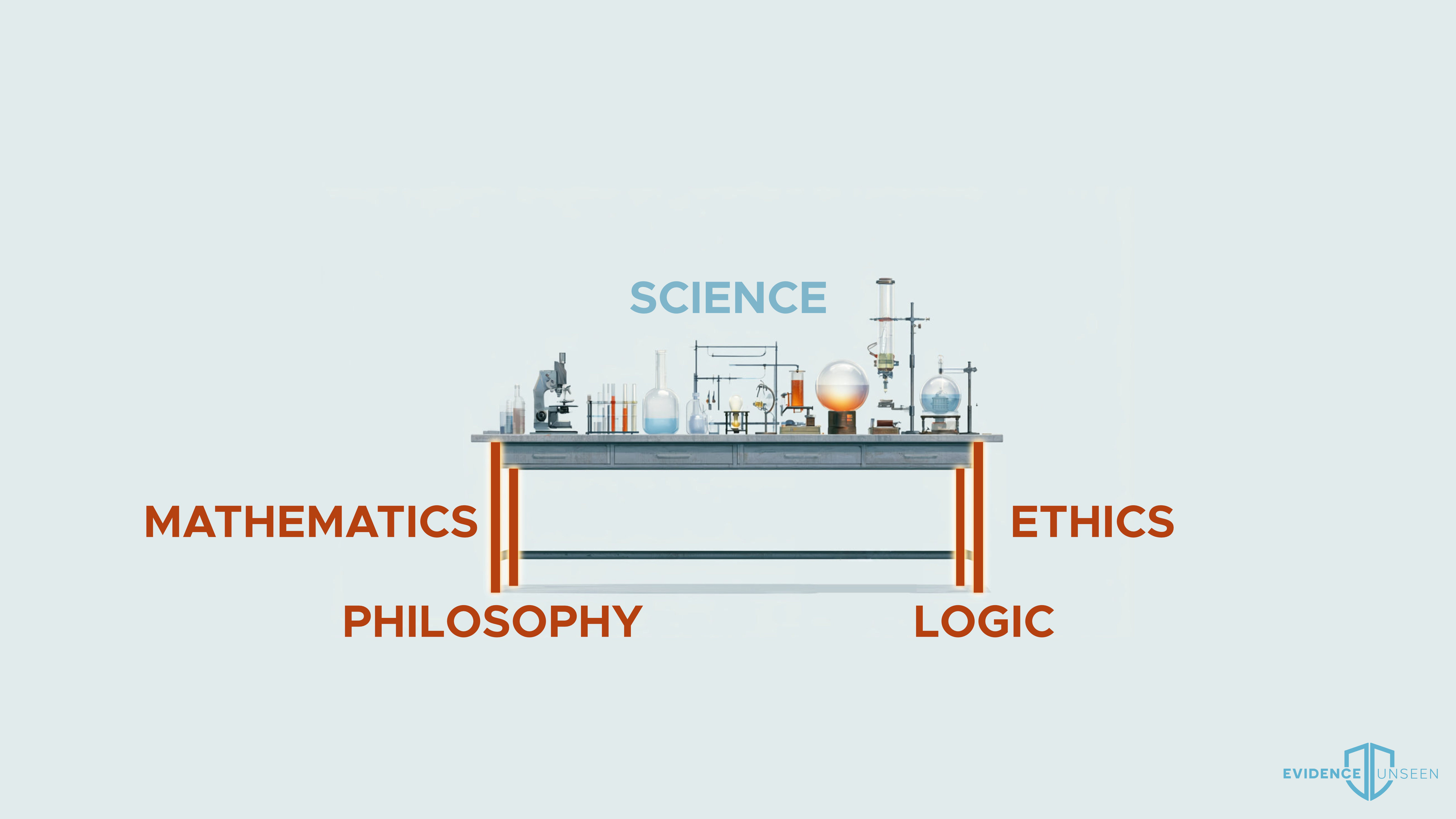
(1) Science depends on philosophy. Consider how necessary philosophy is to science. For one, scientists trust their methodology. They draw observations, raise questions, form hypotheses, run experiments, and draw conclusions and results. More complicated studies look at explanatory power, explanatory scope, simplicity, and coherence. This is all philosophical—not scientific. Without these philosophical methods in place, science couldn’t get off the ground.
Second, scientists trust the uniformity of nature. This refers to the assumption that physical laws are constant, universal, and dependable. It holds that cause-and-effect relationships in the past will be similar to those in the future. If nature wasn’t uniform, then, we would live in a world where physical laws and constants randomly changed. We couldn’t calculate the rise of the sun, the pull of gravity, or the reaction of mixing chemicals.
We assume that nature will continue to be dependable and repeatable in the future. After all, it has always been this way in the past. But how do we know this? Consider an example: for years, people in Europe believed that all swans were white. After all, every single time someone saw a swan, it was white. However, this was disproven when black swans were discovered.
In the same way, perhaps every scientific study has been consistent with regard to gravity so far. But that only relates to the past. We don’t know that the future will be the same as the past—unless we already assume the uniformity of nature. This is viciously circular—as philosophers like David Hume[9] and Karl Popper[10] have both argued. Thus, this problem has vexed philosophers of science, and it remains unsolved after several hundred years.
Third, scientists trust that the physical world is real—not an illusion. What scientific study could we run to prove that the physical world exists? This lies beyond the scope of science. Yet many worldviews and philosophical systems reject the reality of the physical world (e.g. Buddhism, Hinduism, Solipsism, etc.), and science is unable to disprove such a view.
Fourth, scientists trust their sensory and cognitive faculties. However, if neo-Darwinism is true, they have no reason to do so. According to Darwinism, brains developed because they survived long enough to pass on our genetic information to the next generation—not because they could accurately recognize truth. Many truths aren’t advantageous to fitness, and many falsehoods are helpful for biological fitness.
Behavior is much more important than beliefs in a Darwinian view. It’s infinitely better to have the right behavior and flee the predator to pass on your genes than it is to have the right beliefs and get eaten. Again, beliefs and behavior might intersect coincidentally, but at the end of the day, it’s more important to have the right behavior and live, than have the right beliefs and die. On Darwinism, true behavior always trumps true beliefs.
While we might theorize several cases where false beliefs actually helped survival and fitness, we don’t need to. Naturalists offer several examples that naturalists claim are illusions that were beneficial to survival: God, the afterlife, objective morality, and free will. Naturalists say that these beliefs are all false, but these were favorable for social communities and the survival of cooperative primates like humans. So, in each case, we believed certain things—not because they were true—but because they favored survival and fitness.
Naturalistic thinkers see this problem. Atheistic cognitive scientist Steven Pinker writes, “Our brains were shaped for fitness, not for truth. Sometimes the truth is adaptive, but sometimes it is not.”[11] Likewise, atheistic philosopher John Gray writes, “If the human mind has evolved in obedience to the imperatives of survival, what reason is there for thinking that it can acquire knowledge of reality, when all that is required in order to reproduce the species is that its errors and illusions are not fatal? A purely naturalistic philosophy cannot account for the knowledge that we believe we possess.”[12]
Indeed, even Charles Darwin saw the difficulty of a naturalistic account of the mind: “With me the horrid doubt always arises whether the convictions of man’s mind, which has been developed from the mind of the lower animals, are of any value or at all trustworthy. Would any one trust in the convictions of a monkey’s mind, if there are any convictions in such a mind?”[13]
In each case listed above, science necessarily depends on philosophy. Without philosophy to bail out science, the entire business of scientific progress would go bankrupt.
(2) Science depends on logic. There are three core laws of logic: (1) The Law of Identity, (2) The Law of Non-Contradiction, and (3) The Law of Excluded Middle. If scientists couldn’t use these laws, the scientific method would collapse.
Consider a practical example. Imagine if you were testing a new antibiotic to determine if it was effective in stopping a bacterial infection.
(i) The Law of Identity. In order to test the antibiotic, you would need to be sure that it retained its identity throughout the clinical trials. Your study would be ruined if you couldn’t demonstrate that you began and ended your trial with the same pill.
(ii) The Law of Non-Contradiction. Without this logical law, you could never falsify your hypothesis. In order for the clinical trial to pass, you would need to show that the antibiotic eliminated the bacteria, rather than helping it. You would need to affirm that infection and non-infection were not both true at the same time.
(iii) The Law of Excluded Middle. To see if your hypothesis succeeds or fails, you would need to see if the antibiotic removed the bacteria (or not). But both couldn’t be true.
Without the canons of logic, all predictions, replication, and experiments would be meaningless.
(3) Science depends on mathematics. You cannot vaguely claim that the bacteria increased or decreased. To show that your hypothesis was true, you would need to show careful mathematical measurements, comparisons, and models. J.P. Moreland writes, “Even though science appeals to the laws of logic and mathematics and thus presupposes them, it cannot justify them. Why? For one thing, logic and mathematics are a priori fields, that is, the relevant laws are warranted by direct rational awareness without any appeal whatever to sense experience. The sciences, however, are a posteriori disciplines that crucially justify their laws and theories by appeal to empirical observations.”[14] If someone tried to prove these through the scientific method, they would be arguing in a circle, because the scientific method assumes these truths.
(4) Science depends on ethics. Scientists need to trust that each other ethically report their findings truthfully. But morality is not found in a test tube. Science presupposes that researchers should be honest with their results, but honesty lies outside the domain of scientific discovery—not within it.
Scientists are humans like the rest of us. They can lie, misreport, or manipulate with their findings. In Nazi Germany, Joseph Goebbels—the propaganda chief—appealed to eugenics to argue that there were lower races within the human species (e.g. Jews, physically and mentally disabled persons, etc.). The Third Reich pressured scientists to produce studies that confirmed these falsehoods. This led to forced sterilization, euthanasia, and the death camps.[15]
A few years ago, scientists began to question whether Pluto should be classified as a planet. When I heard the news, I immediately said, “Wow! I always thought Pluto was a planet… Now, what’s for breakfast…” The certainty of my knowledge of Pluto was not that strong either way. Now, on the other hand, if someone announced, “Torturing babies for fun is a morally good thing to do,” I wouldn’t have had the same reaction! This is because I’m more certain of this truth, than I am of most scientific truths. Moral truths and realities can be directly perceived, and we would even be able to grasp these with more confidence than other truths about the world.
If science depends on logic, math, philosophy, and ethics, then these truths are stronger beliefs than scientific beliefs. J.P. Moreland writes, “It is generally (though not universally) agreed that greater rational certainty is available for a priori truths than for a posteriori truths.”[16]
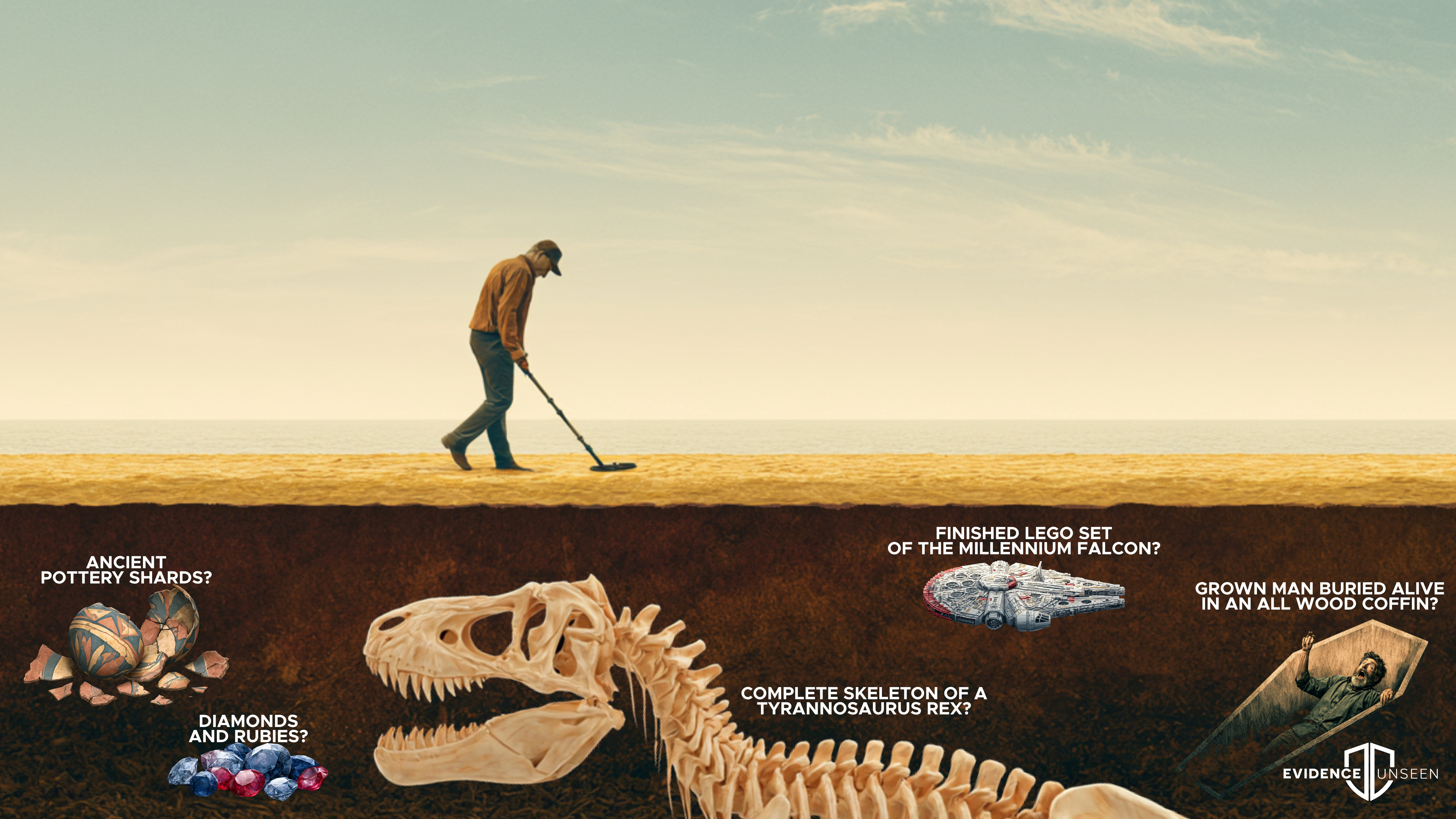
The scientific method offers knowledge within its limited field, but it does not offer unlimited knowledge. Philosopher Edward Feser relates this to the reliability of metal detectors in restricting our field of knowledge:
(1) Metal detectors have had far greater success in finding coins and other metallic objects in more places than any other method has.
(2) Therefore what metal detectors reveal to us (coins and other metallic objects) is all that is real.
But this is a terrible exaggeration of the instrument. The same is true of science. Imagine listening to an opera singer performing “Nessun Dorma” from the Italian composer Giacomo Puccini. As the cymbals clash and the strings reach a crescendo, the tenor holds the final high note, bringing the house down.

If you asked an adherent of scientism about the performance, he might observe, “The diaphragm allowed pressurized air to pass through the larynx and vocal folds. The subglottal pressure caused vibration and oscillation, producing the noise in the oral cavity of man’s mouth…” Of course, this explanation is right… but it completely misses the point! Scientific explanations aren’t wrong; they simply aren’t exhaustive. Likewise, science discovers some truths, but certainly not all. Indeed, scientism effectively eliminates most subjects in the university (e.g. history, literature, linguistics, art, music, etc.).
Consider if a Police commissioner told a detective to solve a murder case. As they observe the evidence, he tells the detective, “Let’s go out and find the murderer.” But as the detective turns to leave, the commissioner winks and says, “One more thing… Let’s make sure that the killer is black.” Of course, this racial bias would affect the way the detective would perform his forensic investigation. Of course, it’s easy to see the problem here: What if this assumption isn’t true? What if the criminal isn’t black? The detective and commissioner would be forcing the evidence to fit a person that wasn’t responsible for the crime.
Similarly, when proponents of scientism do not allow for supernatural causes, they will force the evidence to fit a naturalistic cause. If we assume design is impossible, then it wouldn’t matter how much evidence supports design; we will always assume that natural causes are responsible. Thus by assuming scientism, this would surely give us the best naturalistic explanation, but it might not be the most plausible one. In the same way, if we just assume that nothing in our world can be intelligently caused, then we might neglect the most plausible explanation based on our prejudical assumptions, rather than the evidence itself.
When investigating our world, our primary question should not be, “Is this the best naturalistic explanation?” Instead, our central question should be, “Is this the true explanation?” Put another way, how do we know that we aren’t excluding the true explanation, simply because of a naturalistic bias? If science has limits in its understanding, which theism can explain, then why wouldn’t we be open to this as a possible explanation?
Weak scientism faces the same difficulties as strong scientism. J.P. Moreland writes, “Weak scientism believes that a claim based on an assumption has greater warrant than the strength of the assumption itself. In reality, though, the claim is only as good as the assumption upon which it rests. And because the assumptions are not scientific assumptions, but rather philosophical assumptions, philosophy has a kind of primacy over science. Therefore, weak scientism’s claim that science always takes precedence over other disciplines is false.”[17]
Scientism suffers from several key flaws as a theory of knowledge (i.e. epistemology), and it should be resolutely rejected. As one author writes, “The goal of philosophy is to explain the facts of experience, not to deny them. Anything less is ducking the issue. The problem with reductionism is that instead of explaining things, it tries to explain them away.”[18]
J.P. Moreland, Scientism and Secularism: Learning to Respond to a Dangerous Ideology (Wheaton, IL: Crossway, 2018).
J.P. Moreland and William Lane Craig, Philosophical Foundations for a Christian Worldview (Downers Grove, IL: InterVarsity, 2003), see Part III “Metaphysics” and Part IV “Philosophy of Science.”
John Lennox, Can Science Explain Everything? (London: The Good Book Company, 2019).
C.S. Lewis, Miracles: A Preliminary Study (New York: Macmillan, 1947).
Marcelo Gleiser, The Island of Knowledge: The Limits of Science and the Search for Meaning (Basic Books, 2014).
[1] Internet Encyclopedia of Philosophy, “The New Atheists” https://iep.utm.edu/new-atheism/
[2] Richard Lewontin, “Billions and Billions of Demons.” The New York Review of Books (January 9, 1997).
[3] Paul Horwich, “Review of J. R. Lucas, The Future,” British Journal for the Philosophy of Science 44 (1993): 579. Cited in Paul Copan, How Do You Know You’re Not Wrong (Grand Rapids, MI: Baker Books, 2005), 60.
[4] Bertrand Russell, Science and Religion (Oxford: Oxford University Press, 1935), 235.
[5] Alexander Rosenberg, The Atheist’s Guide to Reality: Enjoying Life without Illusions (New York: W.W. Norton, 2011), 6-7.
[6] Alexander Rosenberg, The Atheist’s Guide to Reality: Enjoying Life without Illusions (New York: W.W. Norton, 2011), 20.
[7] Paul Thagard, The Brain and the Meaning of Life (Princeton University Press, 2010), 8.
[8] Paul Thagard, The Brain and the Meaning of Life (Princeton University Press, 2010), 41.
[9] David Hume, An Enquiry Concerning Human Understanding, ed. Tom L. Beauchamp (Oxford: Oxford University Press, 1999), see Section IV: “Sceptical Doubts Concerning the Operations of the Understanding.”
[10] Karl R. Popper, The Logic of Scientific Discovery (London: Routledge, 2002).
[11] Steven Pinker, How the Mind Works (New York: W. W. Norton, 1997), 305.
[12] John Gray, “The Closed Mind of Richard Dawkins.” New Republic (October 2, 2014).
[13] Charles Darwin to W. Graham, July 3, 1881, in The Life and Letters of Charles Darwin, ed. Francis Darwin (1897; repr., Boston: Elibron, 2005), 1:285.
[14] J.P. Moreland, Scientism and Secularism: Learning to Respond to a Dangerous Ideology (Wheaton, IL: Crossway, 2018), 55.
[15] Robert Jay Lifton, The Nazi Doctors: Medical Killing and the Psychology of Genocide (New York: Basic Books, 1986).
Robert N. Proctor, Racial Hygiene: Medicine Under the Nazis (Cambridge, MA: Harvard University Press, 1988).
[16] J.P. Moreland, Scientism and Secularism: Learning to Respond to a Dangerous Ideology (Wheaton, IL: Crossway, 2018), 56. Moreland gives another example: People believe in electrons. Yet, theories of the electron have changed over time, and they will continue to change in the future. Yet, there is nothing that could be learned in the future that will change our direct perception of certain objective moral truths (see pp.100-101).
[17] J.P. Moreland, Scientism and Secularism: Learning to Respond to a Dangerous Ideology (Wheaton, IL: Crossway, 2018), 40.
[18] Nancy Pearcey, Finding Truth: 5 Principles for Unmasking Atheism, Secularism, and Other God Substitutes (Colorado Springs: David C. Cook, 2015), 110.
James earned a Master’s degree in Theological Studies from Trinity Evangelical Divinity School, graduating magna cum laude. He is the founder of Evidence Unseen and the author of several books. James enjoys serving as a pastor at Dwell Community Church in Columbus, Ohio, where he lives with his wife and their two sons.